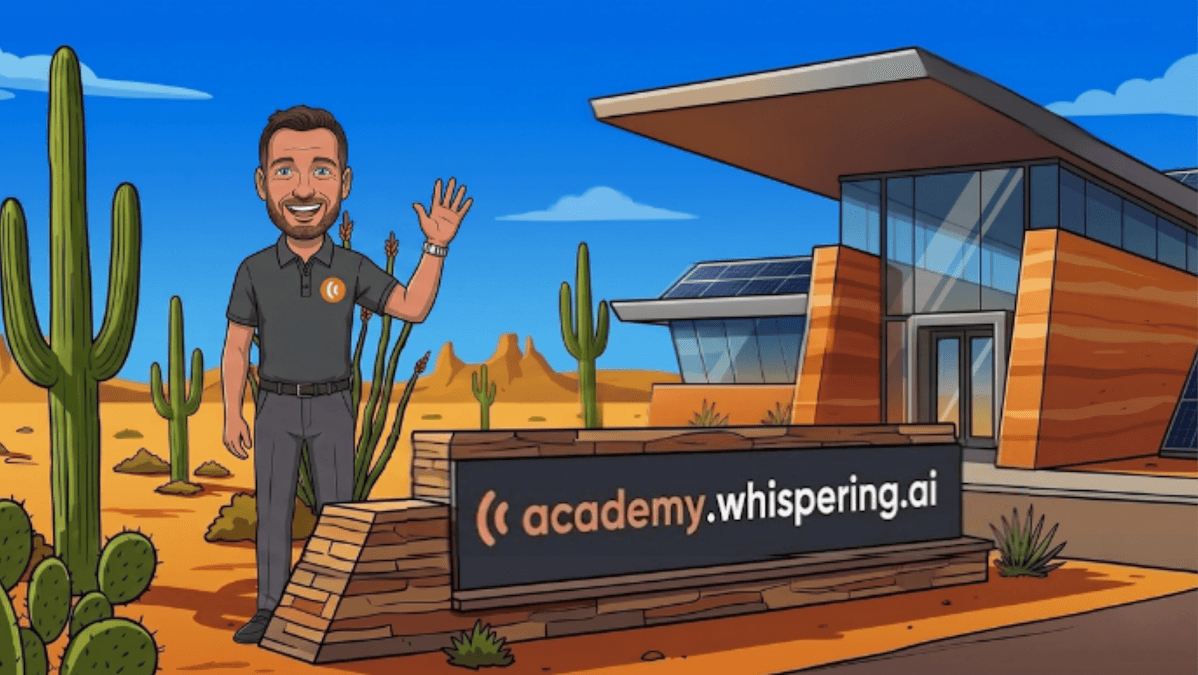
From Two Weeks to One Day: How We Built Instructor Craig
We had a problem. Every course at Whispering AI Academy required Craig, our lead instructor, to write scripts, practice delivery, and record an average of 20 video takes per module. The entire process ate up two solid weeks per course—weeks Craig could have spent building new curriculum or working with students.
So we decided to clone him.
The Voice Cloning Foundation
This wasn't our first rodeo with synthetic voices. Earlier this year, we worked on voice cloning projects in Japan, learning the nuances of capturing natural speech patterns and emotional range. That experience taught us that successful voice cloning isn't just about matching tone—it's about preserving the subtle variations that make speech feel human.
Craig's teaching style relies heavily on emphasis and emotional cues. He doesn't just explain concepts; he guides students through discovery with vocal inflection. A flat, robotic version would kill the learning experience.
Building the Script Intelligence
We started with Claude to handle script generation, but with a twist. Instead of generating plain text, we had Claude write scripts embedded with emotive tags—markup that would tell our voice synthesis exactly how each phrase should be delivered.
A typical script snippet looked like this:
[confident] Now that you understand the basic concept, [curious] let's explore what happens when we add complexity. [reassuring] Don't worry if this feels overwhelming at first—we'll break it down step by step.
These tags became the bridge between Claude's understanding of pedagogical flow and the emotional nuance Craig brings to his teaching.
The Technical Pipeline
Our production pipeline runs in three stages. First, Claude generates the script with emotive markup based on learning objectives and course outline. Second, we feed the tagged script into Eleven Labs, which processes both the text and emotional cues to generate Craig's voice with appropriate intonation and pacing.
Finally, we send the generated audio to Hedra along with an AI-generated image of Craig. Hedra handles the lip-sync and facial animation, creating a video that matches Craig's speaking patterns and mannerisms.
The entire process—from course outline to finished video modules—now takes one day instead of two weeks.
What We Learned About Synthetic Instruction
The biggest surprise wasn't the time savings—we expected that. It was how the emotive tagging forced us to be more intentional about instructional design. When you have to explicitly mark where enthusiasm, concern, or reassurance should appear in a script, you think harder about the emotional journey of learning.
Students can't tell the difference between Instructor Craig and the real Craig in blind tests. More importantly, learning outcomes haven't changed. The synthetic version preserves the pedagogical effectiveness while eliminating the production bottleneck.
We're now using Instructor Craig for all new Academy content, freeing up the real Craig to focus on curriculum development and one-on-one student mentoring—the parts of teaching that still require human intuition and adaptability.
The Broader Implications
This isn't just about making videos faster. It's about scaling expertise without diluting quality. Craig's teaching methodology—his pacing, his emphasis patterns, his way of building confidence—can now be replicated across dozens of courses without burning out our best instructor.
We're already exploring applications beyond the Academy. Client training materials, product demos, and internal documentation could all benefit from this same approach. The key is starting with someone who already has a strong, distinctive voice worth preserving.
If you're building educational content or need to scale expertise across your organization, the tools exist today to make this work. The challenge isn't technical—it's designing the emotional intelligence that makes synthetic voices worth listening to.
Ready to explore AI-powered content creation for your organization? Let's talk about what's possible.