
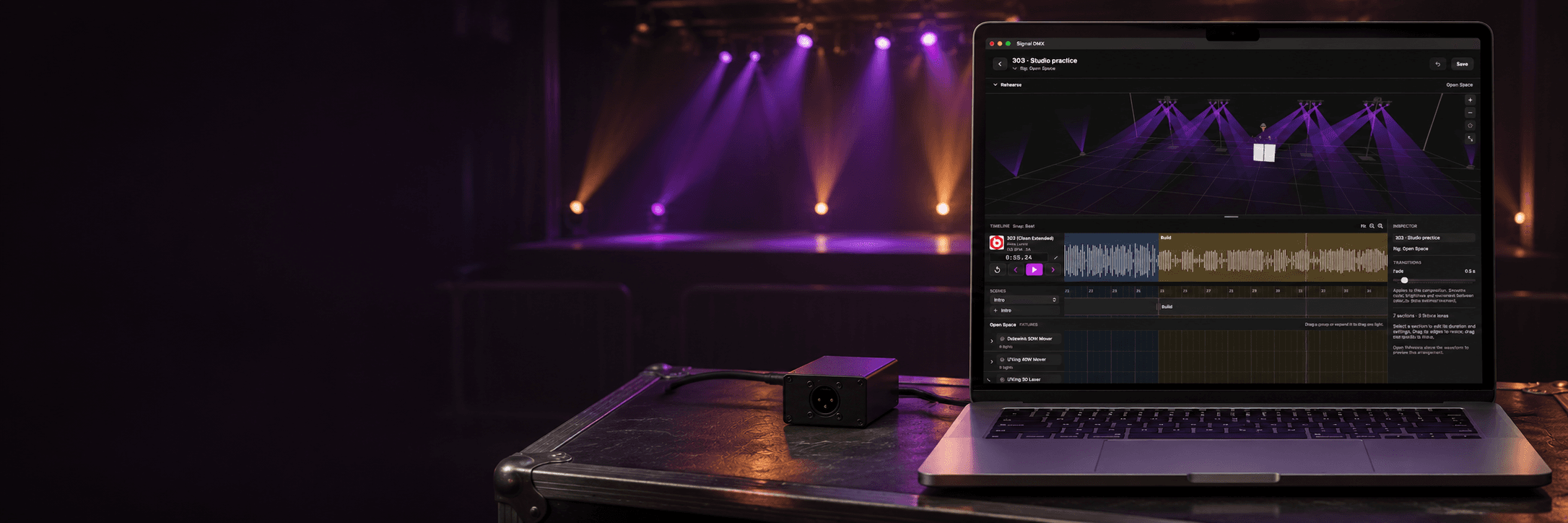
Signal DMX: Prosumer stage lighting with a twist
I was a DJ in Los Angeles in a previous life. Music has always mattered to me, and so has the way lighting changes an experience. A well-timed lighting change can bring drama to a build, make a drop feel bigger, or give a quieter section room to breathe.
What drew me toward stage lighting was the gap between that kind of intention and lights running through the same repeating patterns. I wanted something accessible to a performer who cared about the music but had not spent a year learning to be a lighting engineer.
That gap became the starting point for Signal DMX.
Why a simple creative idea becomes a technical task
Professional lighting relies on DMX. A DMX universe carries up to 512 control addresses, with each value ranging from 0 to 255. Fixtures use those addresses and values to control functions such as color, movement, and effects. ETC's explanation of a DMX universe provides the technical background.
The complication for a newcomer is that fixtures assign their functions differently. A light can also offer multiple modes, each with a different arrangement of controls. Before creating a scene, someone has to understand how the fixtures in their setup are mapped.
The musical intention might be simple: turn a light red and make it blink. Translating that intention into the right fixture settings is where the technical work begins. We wanted to make that process easier while keeping manual control available.
Build the show around beats, bars, and phrases
We based Signal DMX around beats and bars. Significant lighting changes often make the most musical sense at a phrase change, so that became the organizing idea for the experience.
We started with an AI agent trained to analyze music, identify phrase changes, and classify sections such as an intro, buildup, breakdown, drop, break, bridge, or chorus. Those markers give the lighting workflow a structure tied to the song.
During playback, the performer can trigger saved scenes at phrase changes using a companion MIDI pad controller, or let the scenes change automatically. For a song that needs special treatment, they can choreograph a custom show.
The controller workflow supports most DJ controllers as well as MIDI controllers.
The DMX controller also provides full manual control. It is the place to shape scenes and save them for later, building a library the performer can return to.
Let the manual do some of the setup work
Fixture setup was another place where we saw an opportunity for AI. The channel and value information already exists, but it is often buried in an owner's manual.
Signal DMX's setup workflow lets someone upload that manual as a PDF and uses AI to build the fixture's channel-to-function mapping. The aim is to reduce the work of translating a manufacturer's tables into a usable configuration.
This puts AI to work on two distinct problems: understanding the structure of music and interpreting the technical documentation of a light. Both support the same creative task.
A workspace for preparation, a surface for performance
We are developing the Mac app for precise, more complicated setup work. The iPad app is intended for performances and simpler edits.
The iOS and Android phone apps let users browse their configurations and provide a DMX Fixture Lookup covering 8,000+ fixtures. That lookup is intended to help when a performer encounters an unfamiliar light and needs its patch map.
Signal DMX also includes a simulator. Users can create a 3D space, add lights and equipment, and preview the lighting while working with the pad controller or designing scenes. It gives the scene-building process a visual environment before connecting a physical rig.
Where the development stands
At the time of writing in November 2026, testing has taken place in the simulator. We have acquired physical lights and will begin that integration phase next.
Our planned setup takes the iPad's output through a DMX converter and wireless transmitter to lights fitted with wireless receivers. Testing that complete path with actual fixtures is still ahead. The simulator work is progress toward that stage, rather than a claim that the physical setup has already been validated.
Buy the apps, subscribe for AI services
The plan is to offer the desktop, tablet, and mobile apps as one-time purchases. Configurations will primarily sync through the user's own cloud drive. AI analysis and additional services will be available through a subscription.
Pricing is still being worked out. The intent is to let people buy the core apps while making the services with ongoing costs available separately.
Signal DMX began with a musical ambition: make purposeful lighting more approachable for the people creating the performance. The work so far has focused on connecting musical structure, fixture setup, and scene design into that experience. Physical-light testing is the next step in finding out how it holds together outside the simulator.
Where does technical setup interrupt the creative work you want to do? Start by separating the creative decisions from the translation work between tools, then try simplifying one of those handoffs. That is often where a more useful interface can begin.